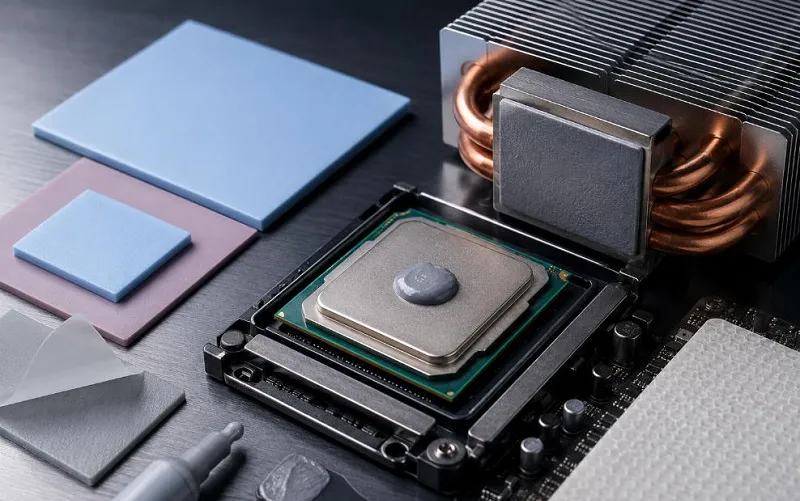


The choice of thermal conductivity is related to the application environment, especially the power of the heat source, the volume of the radiator, and the temperature difference between the two sides of the interface. In general, in desktop processor applications, the thermal conductivity of thermal grease is 3.0w~4.0w/m·K, the higher the effect, the better; in the application of power MOSFET, it is usually recommended to choose 3.0w/ For thermal grease of about m·K, if the working current of IGBT devices is as high as several hundred amperes, it is recommended to use 5.0w/m·K.
Since thermal grease is a liquid interface material, and the application is relatively thin (usually about 0.2-0.3mm), its insulation performance during use is usually not considered. If there are specific requirements for the insulation strength, it can be matched with a ceramic thermal pad to conduct heat Use insulating silicone cloth.
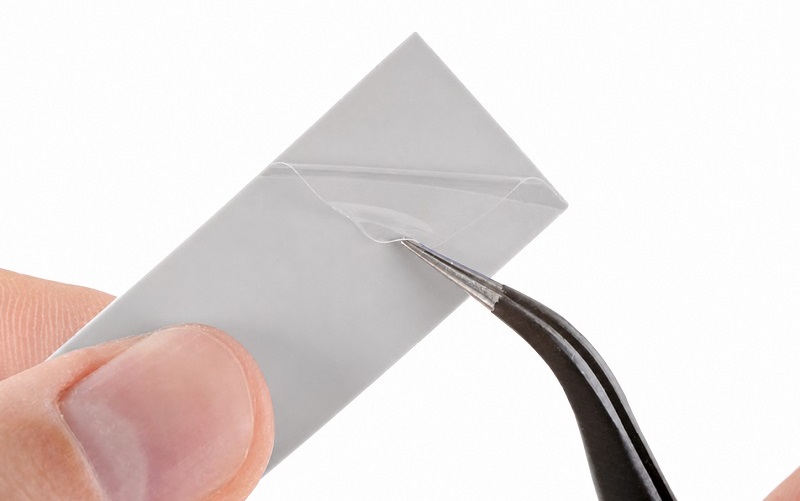
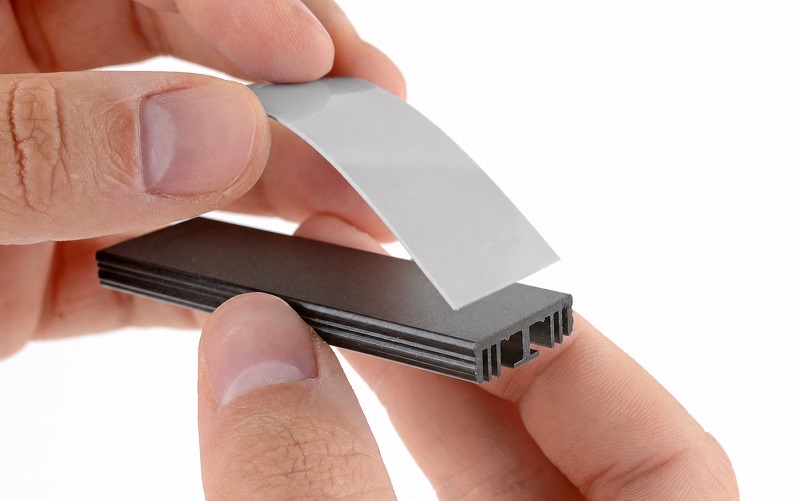
A good caulking material has good wettability and compliance, and can reduce the thermal resistance caused by voids. Thermally conductive gaskets with these two properties can well complete the gap filling function, they can be well absorbed on the surface, and effectively reduce the thermal resistance.
Thermal pad have a wide range of uses, such as: filling cooling devices, communication hardware, automotive control units, LED lighting equipment, PDP displays, etc. In these applications, the thermal pad will produce a certain amount of compression to bridge the gap to achieve good thermal conductivity. The hardness of the thermal pad directly reflects the hardness of the thermal pad, and its size will affect the compression performance of the product, which is a very important parameter. Many people have questions about the hardness when choosing a thermal pad, so I will introduce the hardness of the thermal pad.
Hardness is a mechanical performance index that various mechanical parts and tools must have. It is used to characterize the hardness of the material and refers to the ability of the material to resist local deformation, especially plastic deformation, indentation or scratches.
As different test methods are specified, there are different hardness standards. Various hardness standards have different mechanical meanings and cannot be directly converted to each other, but they can be compared through experiments. Common hardness is classified according to the test method: scratch hardness, indentation hardness, rebound hardness. According to the specific hardness name classification: Rockwell hardness, Brinell hardness, Leeb hardness, Shore hardness and so on. According to the standard ASTM D2240 "Standard Test Method for Testing the Hardness of Rubber with a Hardness Tester", the thermal pad uses Shore hardness to express its hardness. The corresponding measuring instrument of Shore hardness is Shore hardness tester, which is mainly divided into three types: Type A, Type C and Type 00. The measurement principle is exactly the same, the difference is that the size of the stylus, especially the tip diameter, is different, type 00 is the largest and type A the smallest. Shore A hardness tester is suitable for measuring harder thermally conductive gaskets; Shore 00 hardness tester is suitable for measuring softer thermally conductive gaskets. Shore hardness belongs to indentation hardness. The test method is to insert the measured material with a Shore hardness tester. The pointer on the dial is connected to a needle through a spring, and the needle is pierced into the surface of the object to be tested. The value displayed on the dial is the hardness. value.
In the thermal conductivity industry, thermal conductivity is an important parameter reflecting the thermal conductivity of materials. However, in practical applications, it is often not enough to use thermal conductivity alone to assess whether the product is applicable. We often need to introduce another parameter (thermal resistance or thermal impedance) to help judge.
The definition of thermal resistance is the ratio between the temperature difference between the two ends of the object and the power of the heat source when heat is transferred to the object. It can be understood as the resistance encountered by heat on the heat flow path, reflecting the size of the medium or the heat transfer capacity between the mediums, and indicating the size of the temperature rise caused by 1W of heat, in K/W or °C/W. A simple analogy can be used to explain the meaning of thermal resistance. Heat exchange is equivalent to current, temperature difference is equivalent to voltage, and thermal resistance is equivalent to resistance.
At present, the main measures to reduce contact thermal resistance are:
1. Increase the pressure on the contact surface between objects to deform the protrusion on the object interface, thereby reducing the gap and increasing the contact surface.
2. Fill the gap between the two objects with the thermal conductive material, and try to exhaust the air, such as using thermal pads.




 +86 755 2976 5899

 English