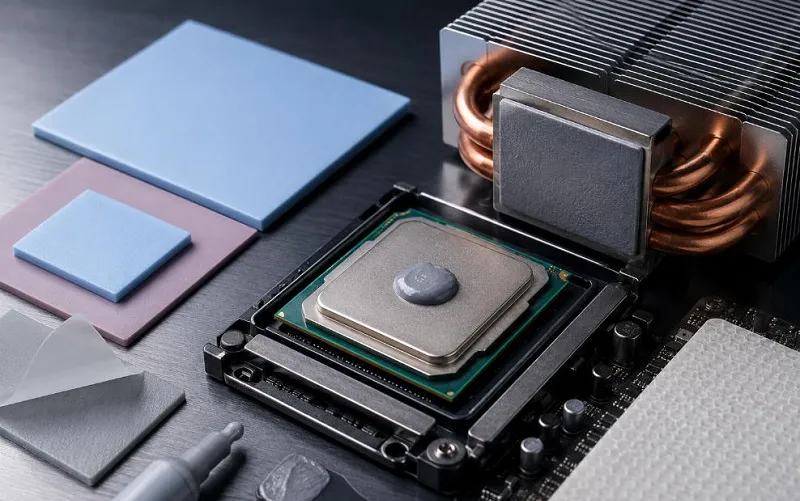


As per reports the factory supplied thermal paste is good for about 1~1.5 years at most and then begins to degrade in performance which leads to the heating of the processor of the laptop.
So it is said that as a precautionary measure you should change the thermal paste to a better quality one with time so as to keep the hardware health of the laptop in peak condition for a longer period of time.
The 0.03 W/m*K figure doesn't take convection into account, which will become the dominant form of heat transfer if there is adequate room for it to occur (at normal electronics operating temperatures). As the gap increases, the thermal compound will become limited by the thermal gradient inside the compound while air cooling will more closely approximate free-air convection conditions. You will probably have to perform a detailed analysis to determine which is better. There are of course exceptions, but thermal potting compound should be chosen primarily because you need potting for your application. If you just need to get rid of heat, there are plenty of other options that are easier to work with - thermal pads, thermal grease, heatsinks, heatpipes - that don't make your device impossible to repair and don't expose you to e.g. triethylenetetramine.
A and B component materials should be mixed in the specified mixing ratio within a tolerance of +/- 5% to ensure material properties. If there are light streaks or marbling in the material, it indicates insufficient mixing.
AOK adopts ISO22007-2 standard
Due to the thixotropic characteristics of most Gap Fillers, special consideration should be given to the test method(s) used to determine viscosity of these materials. Because the material viscosity is dependent on shear rate, different measurement equipment testing under varying shear rates will produce varied viscosity readings. When comparing apparent viscosities of multiple materials, it is important to ensure that the data was generated using the same test method and test conditions (therefore the same shear rate).
It is to use a high thermal conductivity material to make a heat sink (the thermal conductive silicone sheet with a back silicone cloth has a wide range of applications), which is connected to the power battery pack to take away the heat generated by the battery when it is working, and naturally dissipate it into the air. This cooling method is relatively passive, and the cooling effect is not very good, but the cost is lower.
On the basis of natural heat dissipation, a fan with heat sink is installed to increase the heat dissipation area and air circulation speed, so that the heat inside the power battery pack can be quickly dissipated.
1. A cooling fan is installed at one end of the power battery pack, and ventilation holes are left at the other end to accelerate the flow of air between the gaps of the cells and take away the high heat generated by the cells during operation;
2. Add a thermally conductive silicone sheet to the top and bottom of the electrode, so that the heat that is not easily dissipated at both ends is conducted on the metal shell to dissipate heat through the thermally conductive silicone pad. Very good protection.
It is to add a set of liquid cooling radiator to the power battery pack and form a circuit. After the heat generated by the battery is transferred to the liquid in the radiator, the liquid generates convection due to the heat transfer, so that the liquid can flow by itself in the circuit, thereby carrying heat.
1. The heat of the battery cell is transferred to the liquid cooling tube through the thermal conductive silicone sheet, and the heat is taken away by the principle of thermal expansion and contraction of the cold liquid, so that the temperature of the entire power battery pack is unified, and the strong specific heat capacity of the cold liquid absorbs electricity. The heat generated when the core is working makes the entire battery pack operate within a reliable temperature;
2. The thermally conductive silicone sheet has good high resilience and insulation performance, which can avoid the problem of vibration and friction damage between the cells and the hidden danger of short circuit between the cells. It is a good auxiliary material for the water cooling scheme.
It is to use the process of gas-liquid change of the refrigerant as a heat exchange medium to rapidly decrease the temperature of the power battery. This method has the best heat dissipation effect and the highest cost.
At present, the power batteries of new energy vehicles are mostly air-cooled and liquid-cooled.
The electrically insulating thermal sheet is a sheet of cloth-like thermally conductive insulating material produced by special processes such as coating and casting as the base material of silica gel and glass fiber (or polyimide film, English Polyimide film, referred to as "PI film"). product. Because of its excellent thermal conductivity, insulation, high dielectric constant, low thermal resistance and easy assembly, it is widely used in electronic appliances and other industries.
This situation is mainly due to the precipitation of silicone oil in the thermal grease. Due to the volatilization of silicone oil, the thermal grease is not uniformly distributed, and there will be air gaps in the middle, causing the thermal grease to reduce its heat dissipation effect and become invalid. We can use the degree of oil separation as an index to evaluate the heat resistance and stability of thermally conductive silicone grease: good quality thermally conductive silicone grease has a very low degree of oil separation and tends to zero.
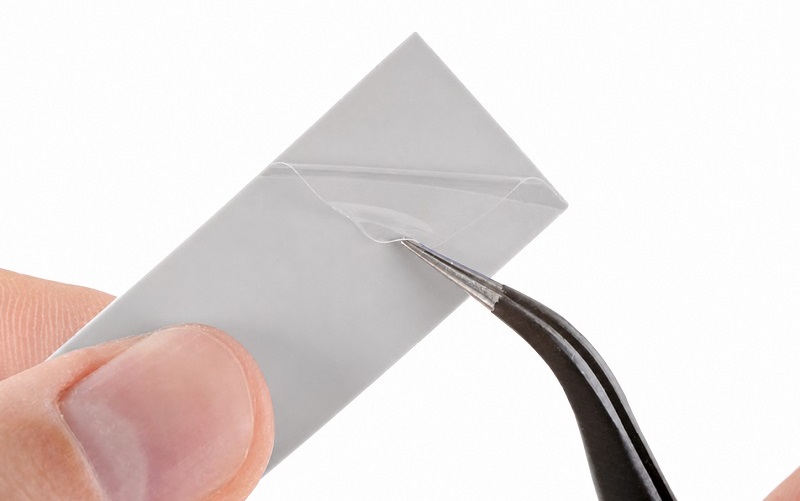
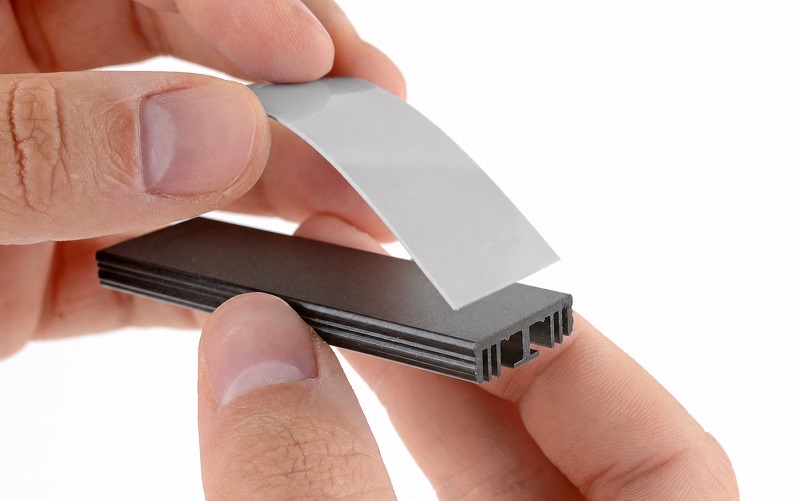
Our thermal pad product itself has the natural characteristics of silicone rubber, has a weak viscosity, and can be easily assembled and applied. This kind of self-adhesiveness is easier to peel off than the back glue, preventing tearing.
At present, our company adopts ASTM D5470 standard




 +86 755 2976 5899

 English