Thermal resistance (Rθ) describes the temperature difference produced by a given heat flow through a defined thermal path and is typically expressed in K/W or °C/W. Thermal conductivity (k), measured in W/m·K, is an intrinsic material property, while thermal resistance also depends on material thickness and contact area. For thermal interface materials, thermal impedance is commonly used to describe interface performance under specified test conditions, including thickness, pressure and contact resistance.
Thermal resistance (R) is an empirical property derived from the often-used analogy between electrical and thermal conduction:
Equation: R = T1 - T2 / q = △T / q
where: T1 = component temperature
T2 = heat-sink temperature
Thermal impedance (Z) is defined as the temperature gradient per unit of heat flux, (q / A), passing through the interface. It's calculated by simply multiplying thermalresistance by the component area:
Equation: Z = △T / (q / A) = R • A
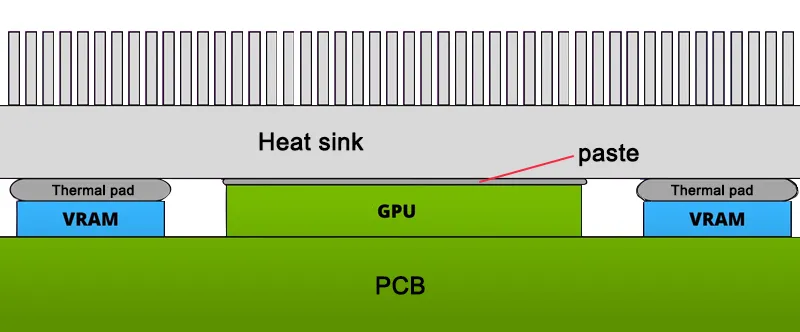
Thermal resistance and thermal impedance are not material properties and should be determined individually for each component/heat-sink configuration. In contrast to thermal conductivity, impedance and resistance reflect the geometry of the assembly, i.e., the size of the component area (“footprint”) and the thickness of the interface material. For pad-based assemblies, thermal pad thermal resistance is also affected by pad thickness, contact area, compression, and interface quality. In addition, they account for any effects that impact the ability of the material to transfer heat between the component and the heat sink (interface resistance). These effects can vary across different types of thermal interface materials because their composition, conformability, and contact behavior are not identical.
Therefore, thermal resistance or impedance are important practical characteristics that often more accurately reflect heat-dissipating capability than thermal conductivity, which neglects interfacial effects.
Thermal resistance and thermal conductivity are related, but they describe different aspects of heat transfer.
Thermal conductivity (k) is a material property that indicates how readily heat can pass through a material. It is normally expressed in W/m·K. Thermal resistance (R) describes the resistance to heat flow through a specific material layer or thermal path, so it also depends on thickness and heat-transfer area.
Property | Thermal Conductivity | Thermal Resistance |
Typical symbol | k | R or Rθ |
Common unit | W/m·K | K/W or °C/W |
Material property | Yes | No |
Depends on thickness | No | Yes |
Depends on area | No | Yes |
Better heat transfer | Higher value | Lower value |
This distinction is particularly important when selecting thermal interface materials. A higher thermal conductivity value does not by itself guarantee a lower resistance in the final assembly. TIM thickness, contact with the mating surfaces and interface conditions also affect the heat-flow path.
No. Thermal resistance is not simply the inverse of thermal conductivity.
The reciprocal of thermal conductivity is thermal resistivity:
Thermal resistivity = 1 / k
Thermal resistance also takes the dimensions of the thermal path into account:
R = L / (k × A)
For example, increasing the thickness of a material increases its thermal resistance even though the material's thermal conductivity remains unchanged.
This is why thermal conductivity cannot be converted directly into thermal resistance without knowing at least the material thickness and heat-transfer area.
If the thermal conductivity, material thickness and heat-transfer area are known, the bulk thermal resistance of a uniform material layer can be estimated from:
R = L / (k × A)
For example, consider a material with:
Thermal conductivity: 5 W/m·K
Thickness: 1 mm
Heat-transfer area: 20 mm × 20 mm
First convert the dimensions to SI units:
L = 0.001 m
A = 0.02 m × 0.02 m = 0.0004 m²
The calculated thermal resistance is therefore:
R = 0.001 / (5 × 0.0004) = 0.5 K/W
This calculation is useful for understanding the relationship between conductivity, thickness and thermal resistance. It describes heat conduction through the bulk material, however, and does not by itself represent every resistance present in an assembled thermal interface.
In a real TIM application, the interfaces between the material, component and heat sink also influence heat transfer.
If you would like to learn more about AOK performance thermal materials, please visit our website at www.aok-technologies.com.

 +86 755 2976 5899

 English