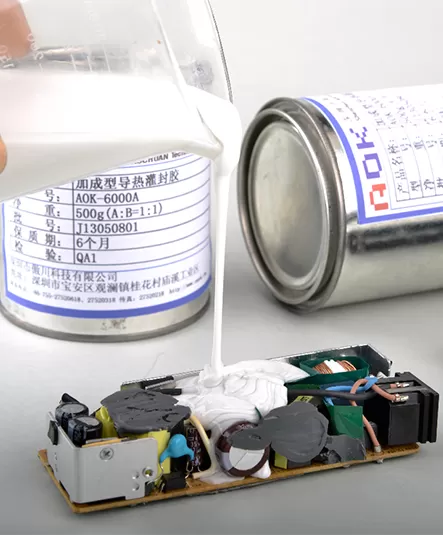
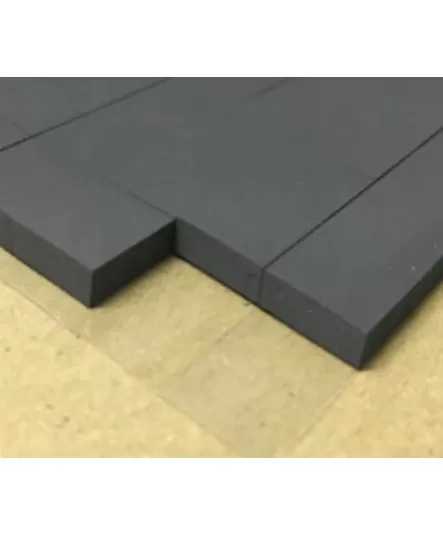
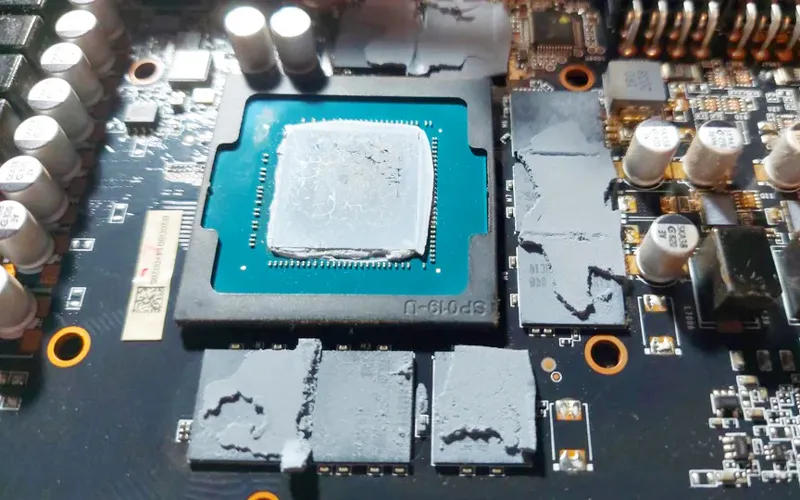
In computing and electronics, thermal pads (also called thermally conductive pads or thermal interface pad) are pre-formed rectangles of solid material commonly found on the underside of heatsinks to aid the conduction of heat away from the component being cooled (such as a CPU or another chip) and into the heatsink (usually made from aluminium or copper). Thermal paste (also called thermal compound, thermal grease, heat sink compound, heat sink paste or CPU grease) is a thermally conductive (but usually electrically insulating) chemical compound, which is commonly used as an interface between heat sinks and heat sources such as high-power semiconductor devices.
Both are designed to reduce the effect of air gaps at the interface and improve heat transfer, but they are not interchangeable in every application.
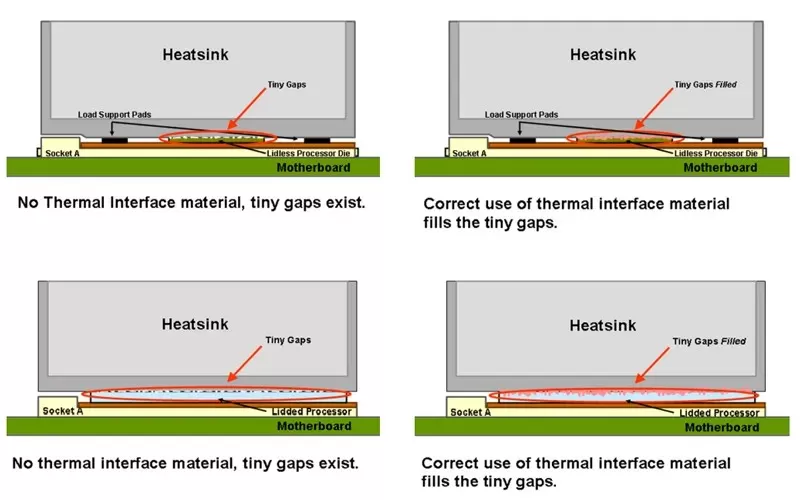
Choosing between them therefore involves more than comparing thermal conductivity values. Gap size, interface thickness, mounting pressure, electrical insulation, assembly process and long-term reliability should all be considered.
Thermal pads and thermal grease are both thermal interface materials, but they are designed for different interface conditions.
A thermal conductive pad is a pre-formed, compressible material available in controlled thicknesses. It can accommodate larger gaps and dimensional tolerances between components and cooling surfaces.
Thermal grease for sale is a dispensable paste used mainly where the mating surfaces are already relatively close together. It fills microscopic surface irregularities rather than serving as a thick gap-filling material.
| Factor | Thermal Pads | Thermal Grease |
| Material form | Pre-formed compressible sheet | Paste-like material |
| Typical interface | Measurable gaps and uneven component heights | Closely mating surfaces |
| Gap-filling capability | Suitable for larger controlled gaps | Primarily fills microscopic surface irregularities |
| Thickness | Available in defined thicknesses | Forms a thin layer after assembly |
| Mechanical compliance | Can accommodate dimensional variation | Limited ability to bridge a physical gap |
| Application | Cut or placed into position | Dispensed or spread onto the surface |
| Assembly cleanliness | Generally easier and cleaner to handle | May require more process control and cleaning |
| Electrical insulation | Available in electrically insulating grades | Depends on formulation; check product data |
| Rework | Pads can often be removed as a piece | Residual grease normally needs to be cleaned |
| Key selection factors | Thickness, hardness, compression, conductivity | Conductivity, viscosity, interface thickness, stability |
• Thermal conductivity of the material
• Electrical conductivity of the material
• Spreading characteristics of the material
• Long-term stability and reliability of the material
• Ease of application
Thermal conductivity is the quantified ability of any material to transfer heat. The thermal conductivity of the interface material has a significant impact on its thermal performance. The higher the thermal conductivity, the more efficient the material is at transferring heat. Materials that have a lower thermal conductivity are less efficient at transferring heat, causing a higher temperature differential to exist across the interface. To overcome this less efficient heat transfer, better thermal management solutions use to achieve the desired heat dissipation.
If you would like to learn more about AOK performance thermal materials, please visit our website at www.aok-technologies.com.

 +86 755 2976 5899

 English