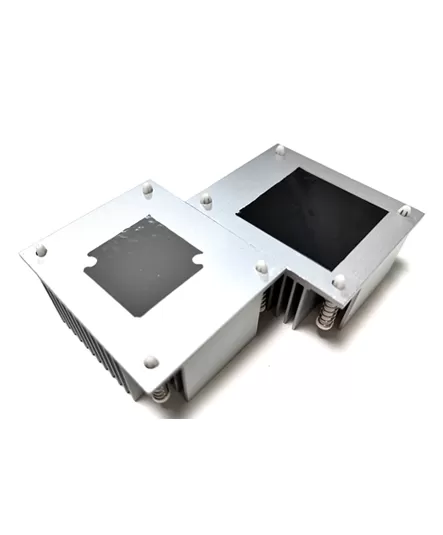
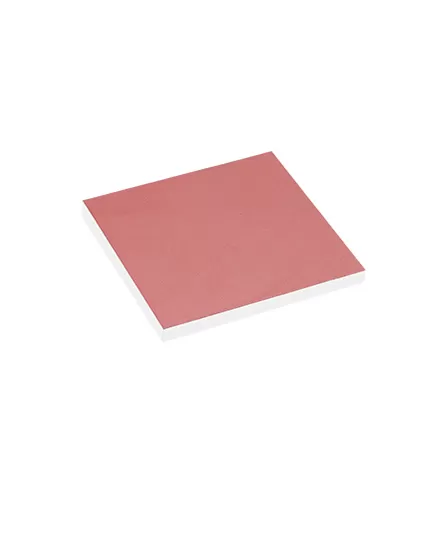
Heat sink thermal grease is a thermal interface material applied between a heat-generating component and a heat sink. It is also commonly called thermal paste, thermal compound, heat sink paste, or CPU grease.
Its job is simple: fill the microscopic gaps left between two solid surfaces so heat can move more efficiently from the component into the heat sink.
Even surfaces that look smooth are not perfectly flat at a microscopic level. When a CPU, GPU, power device, LED module, or other heat source is mounted directly against a heat sink, small air pockets remain between them. Because air transfers heat poorly, these gaps increase interface thermal resistance.
Thermal grease fills these surface irregularities and creates a more continuous thermal path.

Heat sink thermal grease is used to fill gaps between the CPU (central processing unit) or other heat generating components and the mechanical heat sink. The mechanical heat sink, a passive component made of a conductive metal, is placed over the CPU. Heat is drawn from the CPU through the mechanical heat sink to its fins, where a fan blows air through to dissipate the excess heat.
Inefficiencies in the thermal transfer occur because two flat surfaces, e.g. CPU and mechanical heat sink, never join together perfectly. Inevitably, there is an air gap because of imperfect surfaces. Because air is a relatively bad thermal conductor, this gap can lead to a reduction in heat dissipation, and result in an overheating and failing device. Heat sink thermal grease is used to fill that gap and is designed to efficiently transfer the heat from the heat generating component to the heat dissipating device. Although the heat sink thermal grease does not have the thermal conductivity of metals like copper and silver, its conductivity improvement over the air will increase thermal responsiveness.
Heat sink thermal grease does not mechanically connect devices like thermal adhesive does. The mechanical heat sink must be firmly attached using screws or other means to minimize the space between the sink and the source.
Heat sink thermal grease is an older formula more appropriate for use in electrical applications. Silicone is used in combination with zinc oxide to create a paste that applies easily but does not flow into unintended areas. However, silicone oil can migrate from the heat sink compound and cause both solderability issues and conformal coating dewetting.
Thermal grease is best suited to assemblies where the gap between the heat source and heat sink is very small.
Typical applications include:
CPUs and GPUs
Power semiconductors and power modules
LED modules
Power supplies
Telecom and network equipment
Automotive electronics
Other heat-generating electronic components mounted directly to a heat sink
For larger or uneven gaps, thermal grease may not be the best solution. A thermal pad, gap filler, or another type of thermal interface material may provide better gap accommodation and assembly control.
In other words, thermal grease for sale is generally selected for thin interfaces, while compliant pads and gap fillers are better suited to larger mechanical tolerances.
Thermal conductivity is important, but it should not be the only specification used to select a thermal grease.
A higher W/(m·K) value generally indicates that the material itself can conduct heat more effectively. However, actual interface performance also depends on how the grease behaves after assembly.
Thermal grease normally performs best as a thin interface layer. A material that wets both surfaces well and forms a small bond line can reduce overall interface thermal resistance.
The grease needs to spread sufficiently under assembly pressure to fill surface irregularities without flowing uncontrollably away from the interface.
For electronics exposed to repeated heating and cooling, consider whether the grease can maintain consistent contact over time without excessive drying, separation, or movement.
The grease should remain stable across the operating temperature range of the component and cooling system.
Some assemblies require an electrically insulating thermal interface. Electrical properties should therefore be checked together with thermal performance.
AOK's thermal grease range includes products with thermal conductivity options from 1.0 to 6.0 W/(m·K), including formulations designed for high-temperature operation, low thermal resistance, and long-term reliability.
Not always.
Thermal grease is generally more suitable for thin, tightly controlled interfaces. Thermal pads are compressible and can bridge larger gaps or accommodate variations in component height.
For example, a CPU mounted directly against a cooler may use thermal grease, while memory chips or electronic components positioned at different heights may require thermal pads.
Choosing between them should therefore be based on the actual gap, surface condition, mounting pressure, and assembly requirements rather than thermal conductivity alone.
AOK develops thermal interface materials for electronic thermal management applications, including thermal grease, thermal pads, liquid gap fillers, phase change materials, and other TIM solutions.
Our thermal grease portfolio includes products for different requirements in thermal conductivity, temperature resistance, bond line thickness, and long-term reliability.
If you are selecting thermal grease for a heat sink, the most useful information to provide is:
Heat source and heat sink materials
Contact area
Approximate interface gap
Operating temperature
Required thermal performance
Electrical insulation requirements
Assembly pressure or fastening method
Expected service conditions
These factors make it possible to select a thermal grease based on the real thermal interface rather than on W/(m·K) alone.
If you would like to learn more about AOK performance thermal materials, please visit our website at www.aok-technologies.com.

 +86 755 2976 5899


 English