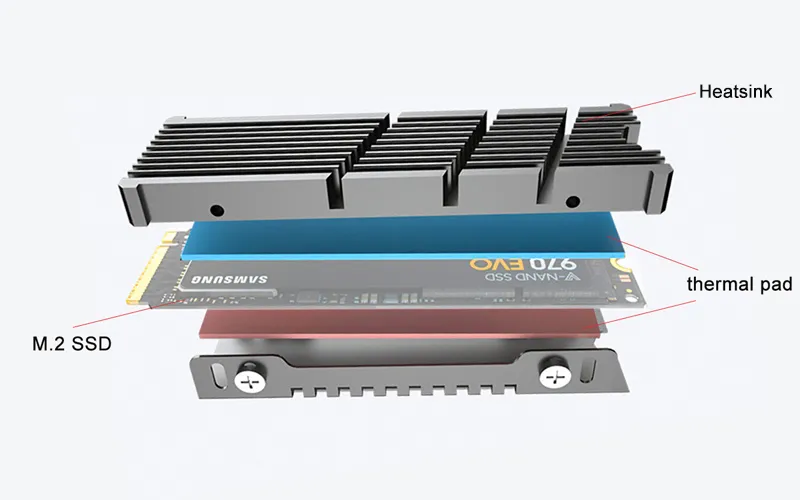
A silicone thermal pad is a pre-formed thermal interface material (TIM) placed between a heat-generating component and a heat spreader or heat sink. It helps bridge small gaps and surface irregularities, creating a more reliable path for heat transfer while potentially providing electrical insulation. The right pad is not necessarily the one with the highest conductivity number: thickness, softness, contact pressure, dielectric requirements and the actual assembly all influence performance. AOK Technologies lists a broad silicone thermal pad range, from very soft gap fillers to higher-conductivity series, so selection should begin with the design conditions rather than a single headline value.
Metal surfaces that appear flat still have microscopic irregularities. When two surfaces are clamped together, air can remain in the interface; because air transfers heat poorly, these voids increase thermal resistance. A compliant pad deforms under the intended mounting pressure and helps maintain contact on both sides. This makes pads useful where a defined gap must be filled, where component heights vary, or where a repeatable pre-cut interface is preferred over a dispensed compound.A pad also has a mechanical role. It must accommodate the gap without applying excessive force to a fragile component, shifting during assembly, or interfering with nearby parts. The target is controlled contact, not maximum compression.
AOK's official silicone thermal pad page identifies a range of series, including UTP100, TP120, TP150, TP200, TP300, TP400, TP500, TP600, TP700, TP800, TP1000, TP1200 and TP1500. The published descriptions distinguish these families by softness, conductivity and construction. For example, AOK describes UTP100 as an extremely soft pad with a fiberglass-reinforced liner on one side; TP400 is listed at 4.0 W/m·K; TP500 at 5 W/m·K; TP1000 at 10.0 W/m·K; TP1200 at 12.0 W/m·K; and TP1500 at 15.0 W/m·K. These are family/model-specific statements, not a guarantee that every shape or thickness performs identically.Use these ranges as a shortlist, then open the relevant model page and technical data sheet. Confirm thickness options, hardness, working temperature, dielectric properties, flammability rating and whether the model is adhesive or reinforced. For instance, AOK describes TP600 as self-adhesive on both sides, while UTP100 is described as single-side self-adhesive. That distinction can affect handling and rework.

Thermal conductivity and system resistance. Conductivity indicates the material's ability to conduct heat, but it does not independently predict component temperature. The thickness of the interface, contact quality, pressure, heat-sink capacity and airflow also matter. Compare data measured using comparable methods.
Gap and thickness. Measure the real gap, including manufacturing tolerance and component-height variation. A pad that is too thin may not contact both surfaces; a pad that is too thick may create unwanted load or assembly interference.
Softness and compression. Softer materials can conform at lower pressure, but the mounting force must remain safe for the component and board. Review hardness and compression information for the specific model.
Electrical isolation. If the pad is near exposed conductors, verify dielectric strength and volume resistivity in the relevant data sheet. Do not infer insulation performance from the word "thermal pad" alone.
Environment and production process. Check temperature range, vibration, aging, flame-retardancy needs, placement method and whether die-cut or sheet formats fit the production line. AOK states that its pads can be supplied as sheets or custom die-cut parts on relevant product information; confirm options for the chosen model.
| Factor | Silicone thermal pad | Thermal grease |
| Form | Pre-formed sheet or die-cut part | Dispensed paste |
| Gap control | Useful for defined gaps and tolerance variation | Often used for very thin interfaces with closely matched surfaces |
| Assembly | Shape and thickness can be specified; convenient for repeatable placement | Dispense amount and spread require process control |
| Electrical/mechanical needs | Model-specific insulation and compliance data can be reviewed | Must evaluate the particular grease and assembly |
| Best next step | Validate pad thickness, compression and contact in a representative build | Validate dispense process, coverage and service requirements |
Neither interface is universally superior. Choose based on gap geometry, allowable pressure, service conditions and measured system performance. The table is a decision aid, not a substitute for thermal testing.
Prepare a specification brief with component and heat-sink materials, contact area, gap range, mounting pressure, operating temperature, electrical-isolation requirements, vibration conditions and target assembly process. If different components have different heights, list each interface separately. Ask the supplier to identify suitable models and provide current data sheets rather than relying on generic family descriptions.Test shortlisted pads in a representative assembly. Record the pad thickness, clamping conditions and thermal test method; inspect for incomplete contact, component deflection, displacement and assembly interference. Recheck after relevant environmental or reliability tests. AOK's silicone thermal pad range is the starting point for reviewing model families, while the exact model documentation should govern final approval.
The best silicone thermal pad balances heat transfer, gap tolerance, compression, electrical requirements and manufacturing practicality. Start with measured assembly conditions, shortlist AOK models using their published specifications, and validate the final choice in a representative build. A higher conductivity value can be useful, but it cannot compensate for poor contact or an unsuitable thickness. For a product recommendation, share the gap, pressure, temperature and insulation requirements alongside the drawing.
Not necessarily. Different component heights and mounting conditions may require different thicknesses.
No. Contact resistance, pad thickness, mounting pressure and the heat-rejection system also affect temperature.
Check the electrical data for the exact model and thickness before using it near exposed conductors.
AOK product information describes sheet and custom die-cut options for applicable products; confirm availability for the selected model.
Follow the model's recommended compression conditions and verify that the component can tolerate the load.
Provide gap dimensions, tolerances, contact area, temperature, mounting pressure, electrical requirements and drawings.

 +86 755 2976 5899


 English