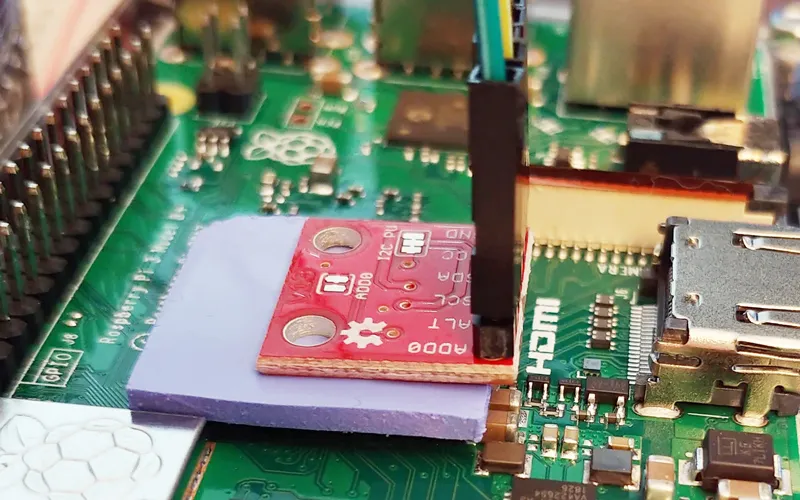
A good thermal pad for an NVMe SSD should do more than have a high W/m·K number. It should have the correct thickness, sufficient softness to conform to the SSD components, reliable electrical insulation and enough thermal conductivity for the actual heat load.
For most NVMe applications, contact quality is more important than selecting the highest thermal conductivity available.
A practical engineering starting point is a soft silicone gap pad in the 2–5 W/(m·K) class when the thermal load is moderate and the contact path is short. Higher-performance 10–15 W/(m·K) materials can be evaluated for hotter storage systems or designs with more demanding thermal targets, but they should only be selected after confirming thickness, hardness and heatsink contact.
There is no single thermal pad specification that is best for every NVMe SSD.
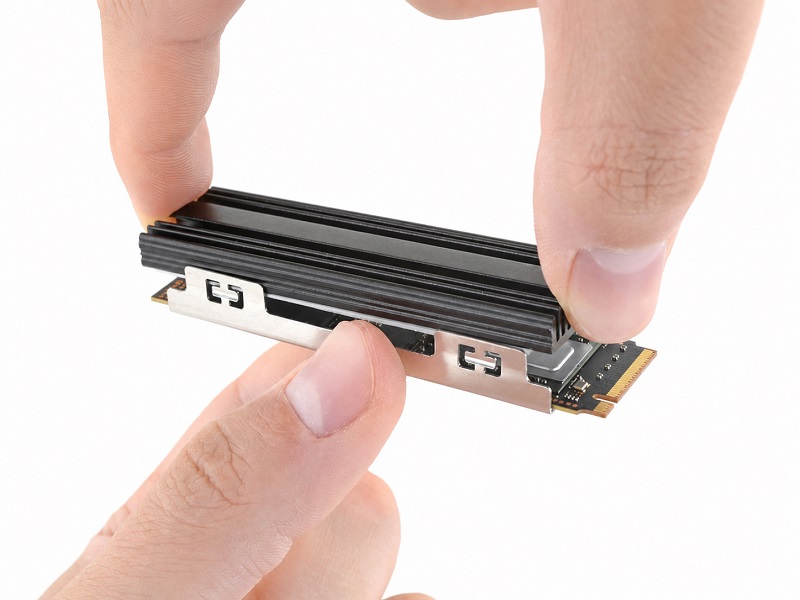
For NVMe cooling, evaluate at least six properties:
Correct thickness
Thermal conductivity
Softness and conformability
Electrical insulation
Surface tack and handling
Long-term stability
The best pad balances all six.
Selection Factor | What to Look For | Why It Matters |
Thickness | Matches the real SSD-to-heatsink gap | Prevents air gaps or excessive pressure |
Thermal conductivity | Appropriate W/(m·K) for the heat load | Reduces material bulk resistance |
Hardness | Soft enough to conform under available pressure | Improves contact |
Electrical insulation | Verified dielectric properties | Reduces electrical-risk concerns |
Surface tack | Enough to hold during assembly | Improves placement |
Thickness tolerance | Consistent material thickness | Important for OEM assembly |
Die-cut capability | Matches M.2 footprint | Improves production repeatability |
Temperature stability | Suitable for device environment | Supports long-term reliability |
No.
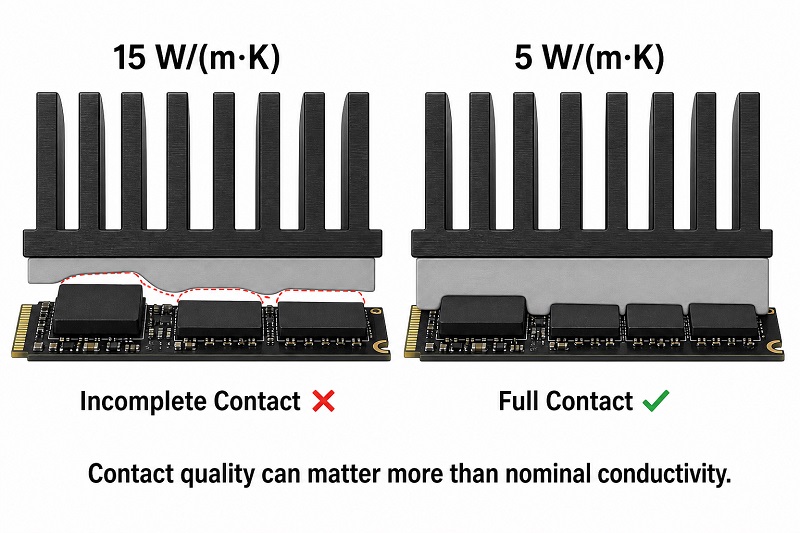
Consider two hypothetical pads.
15 W/(m·K)
too thin
contacts only part of the controller
5 W/(m·K)
correct thickness
conforms evenly across the controller and NAND
Pad B may create the better real thermal path.
This is because heat transfer depends not only on the pad's bulk conductivity but also on:
thickness
contact area
compression
interface contact resistance
heatsink capability
airflow
Kingston's current M.2 cooling guidance makes the same practical point from a fit perspective: the pad must make full, even contact, because too much thickness or too little thickness can both cause problems.
Therefore, when comparing thermal pads, W/m·K should be considered after mechanical fit is established.
There is no official universal minimum conductivity requirement for an NVMe thermal pad.
For engineering selection, a useful way to think about it is in performance tiers.
Thermal Conductivity | Typical Selection Logic |
Around 1.5–2 W/(m·K) | Cost-sensitive designs with good contact and moderate heat load |
Around 3–5 W/(m·K) | Strong general-purpose starting range for electronics cooling |
Around 6–10 W/(m·K) | Higher-performance storage and tighter thermal targets |
12–15 W/(m·K) | High-performance applications where system testing justifies the added conductivity |
These are selection categories, not NVMe standards.
AOK's published product range illustrates this progression.
Its TP150 series provides 1.5 W/(m·K) and specifically lists NVMe SSD, memory modules, desktop computers, laptops and servers among its applications.
TP200 provides 2.0 W/(m·K) and explicitly lists SSD and NVMe applications.
For higher thermal requirements, AOK offers pad families at:
5 W/(m·K)
10 W/(m·K)
12 W/(m·K)
15 W/(m·K)
The correct grade depends on what the complete SSD cooling assembly needs.
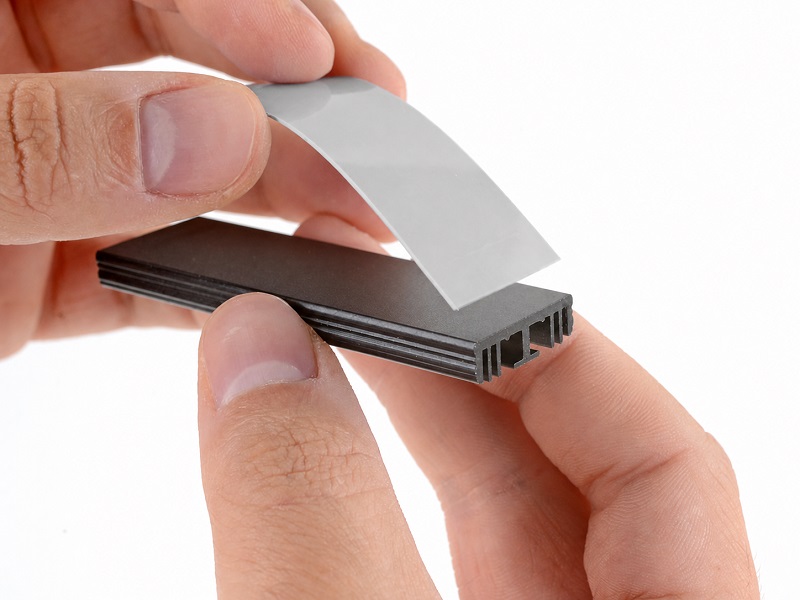
M.2 SSDs are thin PCBs populated with small IC packages.
They are not structures where unlimited clamping pressure should be applied.
A good thermal pad therefore needs to conform to the SSD at relatively low assembly pressure.
Soft pads can compensate for:
controller and NAND height differences
small heatsink flatness variations
PCB tolerances
surface roughness
small differences between SSD models
Henkel describes thermal gap pads as soft, conformable materials designed to eliminate air gaps and reduce interface resistance.
AOK similarly offers ultra-soft thermal-pad grades.
For example, TP200-H25-L has a published Shore 00 hardness of 25, while TP200-H35-S is Shore 00 35. Both provide 2.0 W/(m·K) conductivity.
For a delicate M.2 assembly, a softer 2–5 W/(m·K) pad can sometimes be more appropriate than a much harder high-conductivity pad if the available clamping force is limited.
Thickness must match the gap.
Do not choose a pad simply because another user used the same thickness on a different SSD.
Modern M.2 drives have meaningful differences in component height. A recent test covering 20 motherboards found that only six produced good contact across the tested SSD, largely because M.2 component Z-height varies between drive designs.
For this reason, a good pad should be available in enough thickness options to match the cooling structure.
AOK offers selected thermal pad series from approximately:
0.5 mm at the thin end for selected grades
up to several millimeters for larger electronic gaps
with 0.25 mm thickness increments available in multiple product families.
For OEM development, this is more useful than relying on one “standard NVMe thickness.”
For most conventional SSD/heatsink applications, an electrically insulating thermal pad is a sensible design choice because it may sit directly over electronic components.
The pad should not be assumed electrically insulating simply because it feels like rubber.
Check the technical data.
For example, AOK TP200 grades list breakdown voltage of ≥6.0 kV/mm, while TP500 lists breakdown-voltage values of at least approximately 5–6 kV/mm, depending on the published data section and formulation.
TP1000 also lists breakdown voltage above 6.0 kV/mm.
This is one reason electrically insulating thermal conductive silicone pad materials are widely used for direct contact with electronic packages.
A naturally tacky surface can make M.2 installation easier.
It can help the pad remain positioned while:
the SSD is installed
the motherboard heatsink is lowered
an aftermarket heatsink is assembled
protective films are removed
But tackiness should not be confused with structural adhesive strength.
A thermal pad is primarily a thermal interface material.
AOK's TP150 and TP200 families are both described as naturally tacky, while TP500 is described as double-sided self-adhesive/tacky for easier assembly.
For mass production, liner design and handling may be just as important as tack level.
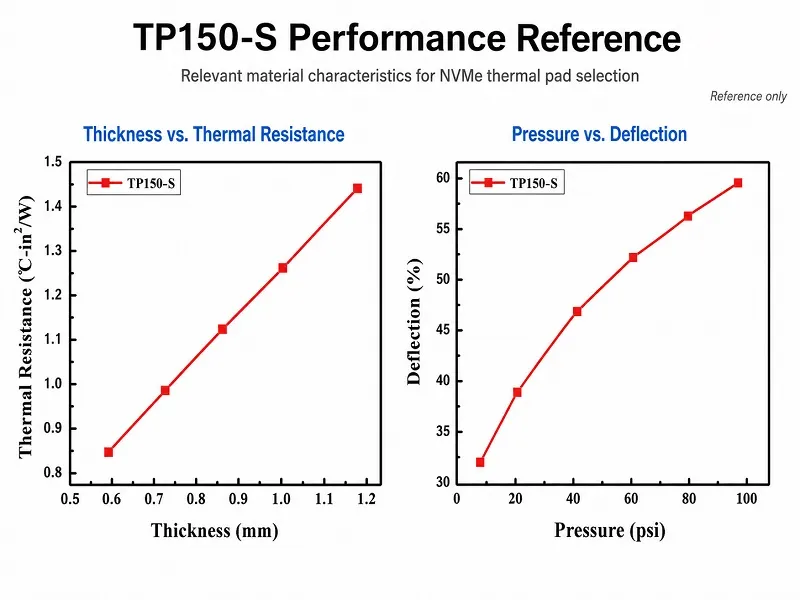
AOK has several relevant performance levels, but they serve different engineering priorities.
Key published properties include:
Thermal conductivity: 1.5 W/(m·K)
Thickness options down to 0.5 mm on selected grades
Naturally tacky
Ultra-soft/highly compliant
NVMe SSD listed as an application
UL 94 V-0
Electrical insulation
This type of pad can be useful when softness and gap conformity are more important than maximum conductivity.
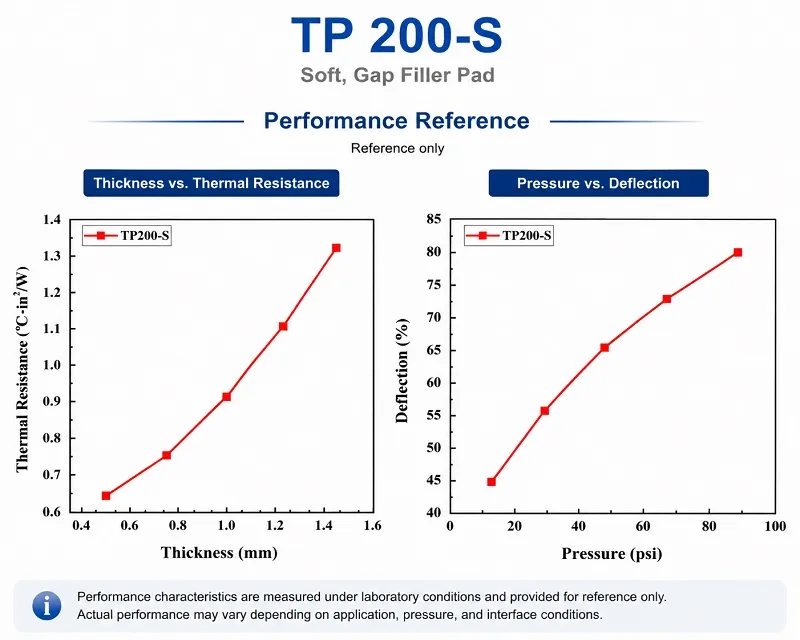
Published properties include:
Thermal conductivity: 2.0 W/(m·K)
Shore 00 hardness as low as 25
Thickness options down to 0.5 mm on selected grades
SSD and NVMe listed as applications
Breakdown voltage ≥6.0 kV/mm
UL 94 V-0
This is a particularly relevant family for NVMe designs with limited assembly pressure.
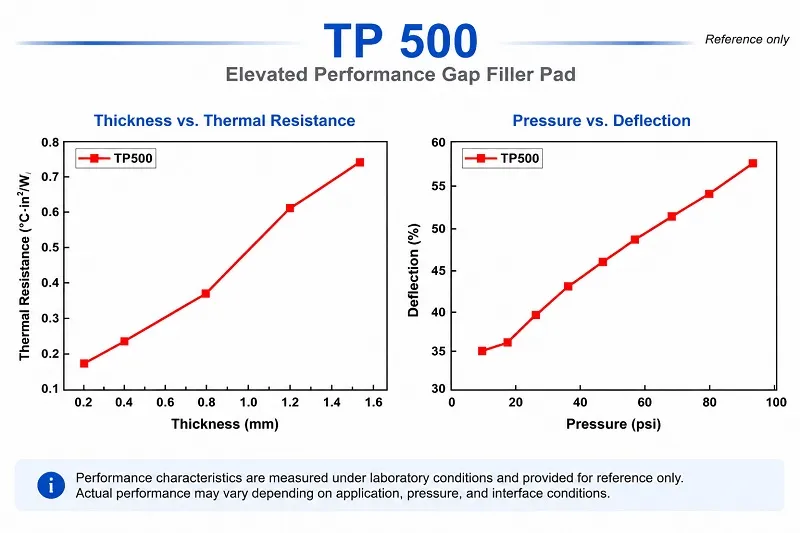
TP500 provides:
5.0 W/(m·K)
0.5–6.0 mm published technical thickness range
high-speed storage listed among its applications
electrical insulation
naturally tacky/double-sided handling
custom die-cut capability
For many higher-performance SSD applications, a 5 W/(m·K)-class pad represents a useful balance between thermal performance and practical material properties.
TP1000 provides 10.0 W/(m·K) and a published thickness range of 0.4–5.0 mm, together with electrical insulation.
AOK also offers 12 and 15 W/(m·K) pad families.
These higher-conductivity materials can be considered where thermal testing demonstrates that additional conductivity is beneficial.
They should not automatically replace a softer lower-conductivity pad if the higher-performance grade increases mechanical stress or reduces contact quality.
High-performance PCIe 5.0 SSDs make good thermal design increasingly important.
Recent motherboard testing demonstrated that poor M.2 heatsink contact can contribute to thermal throttling under sustained workloads. In the same test, an uncooled PCIe 5.0 drive dropped from around 4,000 MB/s to about 1,700 MB/s after throttling began, and later fell further under continued load.
That does not mean every PCIe 5.0 SSD needs a 10 or 15 W/(m·K) pad.
It means the cooling system should be validated under the actual workload.
A good design asks:
Is the controller contacting the pad?
Is the pad contacting the heatsink?
Is compression even?
Is the heatsink large enough?
Is airflow adequate?
Does the SSD remain within its specified operating conditions?
Only then should engineers decide whether higher pad conductivity is needed.
Follow the SSD manufacturer specification rather than a generic internet rule.
For reference, Samsung specifies 0–70°C operating temperature for its 990 PRO, measured using S.M.A.R.T. temperature data, and recommends proper airflow.
Crucial states that most Crucial SSDs also have a specified operating range of 0–70°C.
Different SSDs may start thermal-management behavior at different internal thresholds, so the goal should not be to chase one universal temperature number.
Measure the actual SSD with the intended pad, heatsink, chassis and workload.
For a retail PC repair, users may only care about size and W/m·K.
For an OEM project, the requirements are broader.
When evaluating a thermal pad supplier, ask for:
Thermal conductivity test method
Thickness range and tolerance
Shore hardness
Compression-force data
Dielectric strength
Operating temperature
Flammability rating
Material volatility
Sheet size
Custom die-cut tolerance
Liner options
Shelf life
Lot-to-lot consistency
AOK supplies standard sheets and custom die-cut thermal pads, with multiple series available in 0.25 mm thickness increments.
For storage-device brands, heatsink suppliers or motherboard projects, these manufacturing details can matter more than an isolated conductivity claim.
AOK has developed thermal-management materials since 2004 and supports customers requiring broader thermal interface material manufacturers capabilities across pads, gels, grease, phase-change materials and other TIM technologies.
Before selecting a pad, verify the following:
Mechanical
Correct thickness
Full controller contact
No SSD bending
Suitable softness
Correct die-cut dimensions
Thermal
Appropriate conductivity
Low interface resistance
Sufficient heatsink capacity
Adequate airflow
Electrical
Verified dielectric strength
Electrically insulating formulation where required
Production
Stable thickness tolerance
Easy liner removal
Repeatable positioning
Appropriate tack
Custom die-cut availability
A pad that performs well across these categories is usually a better NVMe solution than one selected only because its package shows the largest W/m·K number.
A 5 W/(m·K) pad can be a strong general-purpose choice when it has the correct thickness, suitable softness and complete heatsink contact. A higher W/m·K rating is not automatically necessary for every SSD.
Its bulk material conductivity is higher, but actual SSD cooling may not improve proportionally. If the 10 W/(m·K) pad is harder, too thick or poorly contacted, a softer 5 W/(m·K) pad may perform better in the complete assembly.
Use the pad supplied with the heatsink where possible. Otherwise, determine the actual SSD-to-heatsink gap and choose a pad that produces complete contact with appropriate compression.
Electrically insulating silicone thermal pads are commonly used in electronics and storage cooling. The exact product's dielectric properties should always be verified from its technical data sheet.
Not automatically. PCIe 5.0 drives can place greater demands on cooling, but thickness, contact, heatsink mass and airflow remain critical. Select conductivity based on thermal testing rather than PCIe generation alone.
Both matter, but poor contact can negate high thermal conductivity. In assemblies with limited clamping force or uneven component heights, softness and conformability may be the first properties to optimize.
A good thermal pad for an NVMe SSD is not simply the pad with the highest conductivity rating.
It is a pad that provides:
correct thickness
complete contact
appropriate softness
sufficient thermal conductivity
electrical insulation
stable long-term performance
For moderate NVMe thermal loads, soft 2–5 W/(m·K) pads can be practical starting points when contact is well controlled. Higher-conductivity 10–15 W/(m·K) materials can be evaluated when thermal testing shows that the application needs additional heat-transfer capability.
AOK offers thermal-pad families from soft NVMe-oriented 1.5 and 2.0 W/(m·K) materials through 5, 10, 12 and 15 W/(m·K) performance grades, together with multiple thicknesses and custom die-cut options.
For an OEM project, the best thermal pad is not necessarily the one with the highest W/m·K rating, but the one that delivers the lowest practical thermal resistance in the actual NVMe SSD, heatsink, and assembly configuration.

 +86 755 2976 5899

 English